Average response time: under 24 hours
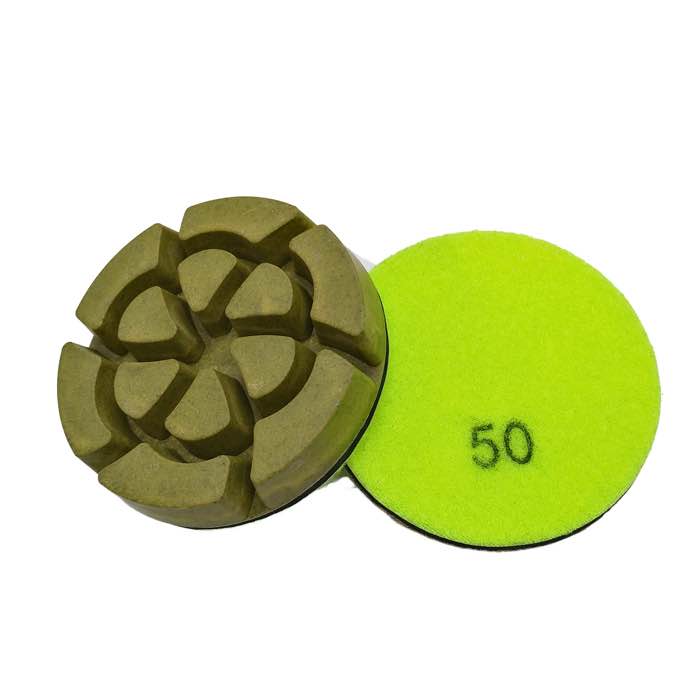
For edge work, corners and countertop or stair details that a walk-behind grinder cannot reach, use 3-inch (75 mm) diamond resin polishing pads on a right-angle grinder or a low-speed hand polisher. Run the same grit sequence you use on the floor body, start at 50 or 100 grit after the metal-bond floor grinding, and step up to 1500 or 3000 grit at the wall so the edge matches the field gloss. The most common failure is skipping grits on edges because the area is small and pressure is applied by hand. A set of 3-inch diamond resin polishing pads (JOY-RFP-05) covers every common edge plate, and dry versions such as the 15 mm thick dry polishing pads (JOY-RFP-06) handle interior jobs where you do not want slurry.
Eighty percent of polished-concrete callbacks start within 30 cm of the wall. The walk-behind grinder leaves 15-25 cm of unground band along every wall, column and door opening, and that band must be finished by hand. Hand work is slower, pressure is uneven, and the operator tends to rush the small area, which is exactly why edges end up duller, scratchier or lower gloss than the center of the room.
Treat the edge band as a separate mini project: grind it first with a cup wheel or edge diamond shoes, then polish it through the same grit ladder as the floor, matching each step exactly. If the floor was ground at 30/40 then 80 then 150 metal bond, the edge must follow the same path before resin pads begin.
3-inch pads use a hook-and-loop (Velcro) backing plate that screws onto the grinder spindle. Check three things before ordering:
For the transition from metal bond to resin on edges, a ceramic-bond step such as the 3-inch ceramic bond transitional pads (JOY-RFP-T1) removes the deep 80/150 grit scratches without leaving the resin pads to do metal-bond work.
| Step | Pad grit | Purpose on edges |
|---|---|---|
| 1 | 50 / 100 | Remove cup-wheel scratches from the edge band |
| 2 | 200 / 400 | Refine scratch pattern, match floor first resin step |
| 3 | 800 | Satin sheen begins |
| 4 | 1500 | Near-gloss |
| 5 | 3000 | Mirror gloss, matches floor burnish |
Spend the same time per square meter on the edge as on the floor. Rushing the 400 grit step is the classic reason the wall band stays hazy after the 1500 pass.
Indoor occupied buildings are usually dry: hook a small HEPA extractor to the grinder and use dry resin pads. Wet polishing at edges creates slurry that runs down the wall, pools at the base and dries as white efflorescence. Wet is preferred only on exterior slabs, pool decks or when dust cannot be controlled. The 15 mm thick dry pads were designed for exactly this hand-held dry operation.
A: Technically they stick, but cut pads shed resin unevenly, overheat and wear in half the time. Buy real 3-inch pads made for the RPM and pressure of hand tools.
A: Almost always because you skipped a grit on the edge or applied too much pressure, which glazes the pad. Re-run the missing grit lightly and let the pad cut at its own pace.
A: Budget 2-3 pads per grit step for a typical 200-400 m2 commercial floor; edges are small, so each pad covers linear meters, not square meters.
A: Most take 3-inch hook-and-loop plates, but verify the backing pad diameter and thread on your specific edge machine before stocking boxes.
Edges win or lose the polished-concrete job. Match the floor grit sequence, control the grinder RPM, and use proper 3-inch pads built for hand pressure rather than cut-up floor pads. JOY TECH supplies 3-inch resin, dry and ceramic-bond edge pads in every grit from 50 to 3000, so the wall band ends at the same gloss as the rest of the slab.
Written and reviewed by JOY TECH - an SGS & BV audited, CE/RoHS certified diamond tools manufacturer founded in 2004, exporting to 50+ countries.
Our factory and quality management system are audited by SGS and Bureau Veritas. Products meet CE/RoHS requirements and every piece is 100% inspected before packing.
Verified Certificates
