Average response time: under 24 hours
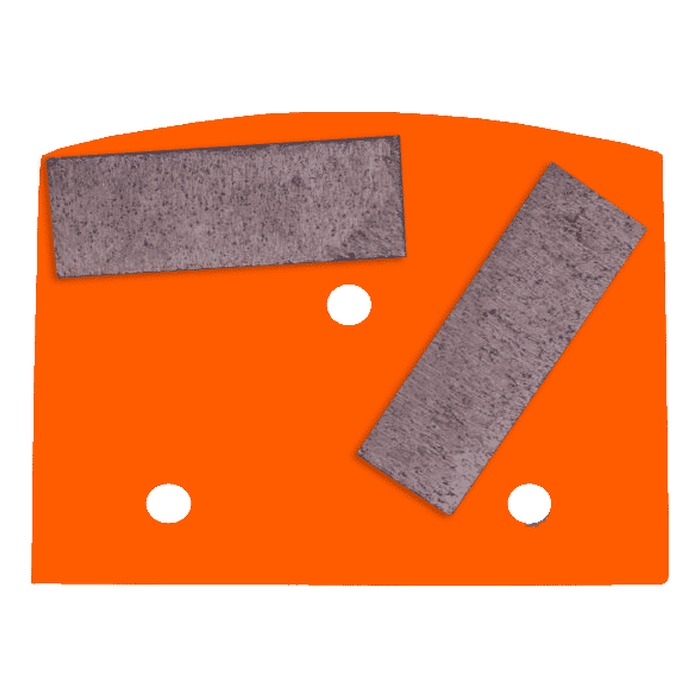
Most bad orders do not fail on quality — they fail on specification. Before you place a container order of grinding blocks for Brazil, fix five things in writing: the connection on your grinding head, the grit range the floor needs, the bond for your slab, the number of blocks per head plus a spare set, and the receiving check you will run on arrival. Get those five right and the second order becomes routine.
Tooling is sold by platform, not by diamond. A Husqvarna Redi Lock block will not seat on a Lavina quick-change head, and Diamatic plates take M6 bolts on a spacing that is not the universal three-hole layout. Photograph the underside of the plate with a ruler across the holes, write down the hole diameter (M6 thread or 9 mm clearance) and the centre-to-centre distance, and send that photo with the enquiry.
| Platform | Connection | Block family to order |
|---|---|---|
| Universal trapezoid head | M6 or 9 mm, three holes | JOY-TP-R3 / TP-S2 / TP-ZG2 / TP-O2 |
| Husqvarna | Redi Lock | JOY-HQS series |
| HTC | HTC plate | JOY-HTCS series |
| Klindex | Quick Lock | JOY-KLD series |
| Scanmaskin | Scanmaskin plate | JOY-SCS series |
| STI PrepMaster | Pin or E/Z plug | JOY-SPS series |
| Terrco | Plug | JOY-TCS series |
| WerkMaster | WerkMaster plate | JOY-WMS series |
| Lavina | Quick Change | JOY-LVS series |
| Diamatic | M6 or 9 mm, Diamatic spacing | JOY-TP-B2 |
If your fleet mixes brands — common in Brazilian contractors that buy used grinders from different suppliers — the practical answer is to standardise on one universal head where you can, and keep platform-specific plates only for the machines that need them.
Grit and bond are set by the concrete, not by preference. A block that glazes on a 40 MPa industrial slab is the wrong bond, and a 6# block on a 20 MPa screed leaves gouges you will spend three passes removing.
| Floor condition | Start with | Bond | Why |
|---|---|---|---|
| Hard, dense slab (high fck, granite / quartz aggregate) | 30/40 | Soft | Keeps diamond exposed; resists glazing |
| Standard industrial or commercial floor | 30/40 | Medium | Default specification for most Brazilian jobs |
| Soft or sandy screed, abrasive aggregate | 30/40 | Hard | Slower bond wear, longer block life |
| Coating or adhesive residue | 16# or 6# | Medium | Removes residue before a 30/40 pass |
| Floor going to resin polish | 30/40 → 60/80 → 100/120 | Medium | Leaves a finish the transitional pads can close |
Ask for the segment height and the segment size in millimetres in the quotation — a 12 mm segment and a 10 mm segment look identical in a photo but deliver very different tool life.
Count blocks per head first: most single-head grinders take three or four, twin-head machines take six to eight. Then add one spare set per machine, because a set that dies mid-shift costs more in downtime than the spare blocks. Order in sets rather than single pieces — mixing new and half-worn blocks on one head leaves the floor wavy and shortens the life of the new ones.
To estimate consumption for your own floor, run a measured test area of 100–200 m² with a new set, record the segment height before and after, and calculate metres per millimetre of wear. That number, not a catalogue claim, is what belongs in your budget.
For any import into Brazil, the commercial invoice, packing list and the product description must match what is actually shipped: platform, block model, segment size, grit and bond. A vague description such as "diamond tools" creates classification doubt at customs, and a mismatched packing list is the fastest way to hold a shipment. Confirm the fiscal classification with your despachante before the goods leave, and keep the approved specification sheet attached to the order so the reference exists on both sides.
Yes, if the connection is the universal three-hole plate. That is the reason most Brazilian contractors standardise on M6 or 9 mm trapezoid blocks and keep only a few platform-specific plates.
Buy the grits your sequence needs — usually 30/40, 60/80 and 100/120 — plus 16# or 6# only if you strip coatings. Supplying every grit in equal quantity leaves you short of the ones you actually run.
Send the measurement photo before production starts, not after. Specification errors are cheap to fix at quotation stage and expensive after the goods are on the water.
Send the machine photo, the slab description and the grit range, and we will return a written specification with plate, segment size, grit and bond for each machine in your fleet. Start from the diamond grinding range, or read how to choose bond and grit.
Written and reviewed by JOY TECH - an SGS & BV audited, CE/RoHS certified diamond tools manufacturer founded in 2004, exporting to 50+ countries.
Our factory and quality management system are audited by SGS and Bureau Veritas. Products meet CE/RoHS requirements and every piece is 100% inspected before packing.
Verified Certificates
