Average response time: under 24 hours
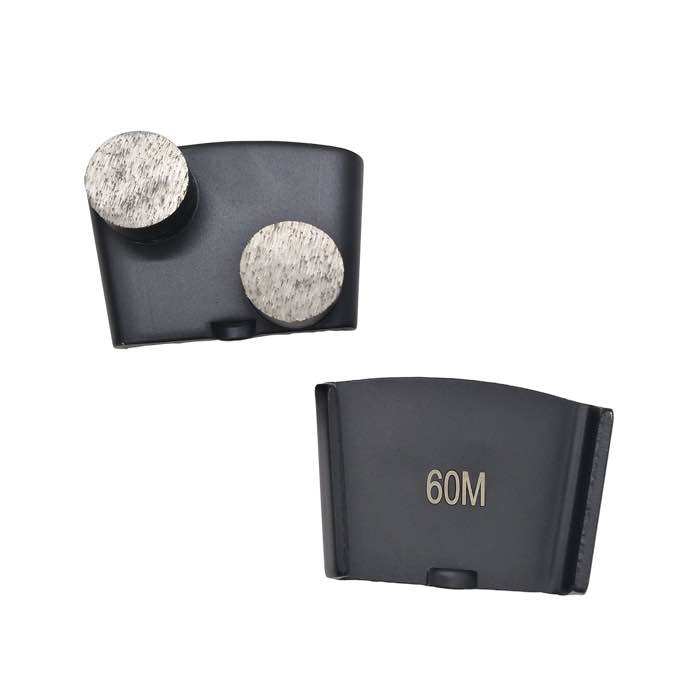
Floor grinders commonly run the planetary head at 300–1,800 RPM, and that range changes how diamond segments wear. Faster RPM (above 1,200) exposes grit quicker and suits a harder bond on soft concrete; slower RPM (below 600) puts more torque into each segment and suits a softer bond on hard concrete. Running a hard-bond segment at low RPM, or a soft-bond segment at high RPM, will cut tool life by 50–70 % and often glaze the head in under 200 m².
Each diamond grain on the segment breaks the paste at a certain impact frequency. At low RPM, each grain bites deeper but the bond does not wear quickly enough to release dull grit — the head glazes. At high RPM, the grains skim the surface, heat the bond, and wear the segment out before the diamonds are spent. The sweet spot depends on concrete hardness:
| Concrete strength | Head RPM range | Bond choice | Typical segment life |
|---|---|---|---|
| < 25 MPa (soft) | 900–1,500 | Hard bond | 600–900 m² |
| 25–35 MPa (medium) | 600–1,200 | Medium bond | 400–600 m² |
| 35–50 MPa (hard) | 300–800 | Soft bond | 250–400 m² |
| > 50 MPa (very hard) | 300–600 | Extra soft | 150–250 m² |
Most walk-behind grinders rotate the head (orbit) and the plate (spin). The relative speed between segment and floor is higher than either number suggests. A 700 RPM head with a 150 RPM planetary can mean a 1,000 RPM cutting speed at the segment face. Always tune bond to effective cutting speed, not to the head tachometer alone.
On soft concrete, the abrasive paste wears the bond faster than the diamonds break. If you use a soft bond, the bond erodes away and you lose diamonds before they are spent — wasting cost. A hard bond holds the grit longer. The reverse is true on hard concrete: hard concrete does not wear the bond, so dull diamonds are never released. A soft bond erodes just enough to refresh the grit.
The HTC double-round segment disc is offered in soft, medium and hard bonds specifically so crews can match this chart on a single machine.
RPM and pressure are not independent. More down-pressure at high RPM increases segment heat and can anneal the metal bond, shortening life sharply. At low RPM, more pressure helps bite into hard paste. A useful rule: if you increase RPM, reduce pressure; if you reduce RPM, you can add weight.
A: Only on soft concrete with a hard bond. On medium/hard slabs, max RPM shortens tool life and often produces a scratched surface because the head skips rather than cuts.
A: A rebound hammer (Schmidt) gives a quick MPa estimate. Rule of thumb: if a 30/40 medium segment cuts less than 30 m² before going dull, the slab is hard — switch to soft bond.
A: Less than for metal segments. Resin pads wear predictably across 1,000–1,800 RPM; the bigger lever is pad pressure and water flow. Use the manufacturer's recommended RPM range.
A: Almost always a bond/RPM mismatch, not a defective set. Confirm bond grade for the concrete strength and drop one bond grade if in doubt.
A quick field test: mount a new set, run a 3 m test strip on a quiet corner, and time how long it takes. Then observe the wear face after 30 minutes. If the face is flat, shiny, and has no exposed diamond grit, the bond is too hard for the RPM — drop a bond grade or raise RPM. If the face is wearing fast and you see whole diamonds falling out, the bond is too soft — raise a bond grade or lower RPM. This 30-minute diagnostic saves hundreds of dollars in wasted tooling on every new job.
| Machine class | Typical head RPM | Best for |
|---|---|---|
| Single-head handheld / edge | 2,500–4,500 | Edges, PCD stripping, small patches |
| Walk-behind 400–600 mm | 1,000–1,800 | Medium slabs, polishing |
| Walk-behind 650–800 mm | 600–1,200 | Open-area grinding, hard concrete |
| Ride-on 800 mm+ | 300–800 | Industrial slabs, high removal |
Match the bond to the machine class — a soft-bond disc designed for a ride-on grinder will glaze in minutes on a high-RPM edge machine.
RPM and bond are two sides of the same wear equation. Match bond hardness to concrete strength, then tune head RPM so the segment wears just fast enough to refresh grit. Keep a mixed set of triple-round trapezoid discs in soft, medium and hard bonds on the truck, and you will never waste a shift on glazed head again.
Written and reviewed by JOY TECH - an SGS & BV audited, CE/RoHS certified diamond tools manufacturer founded in 2004, exporting to 50+ countries.
Our factory and quality management system are audited by SGS and Bureau Veritas. Products meet CE/RoHS requirements and every piece is 100% inspected before packing.
Verified Certificates
