Average response time: under 24 hours
Quick Answer: Move a floor machine across concrete at about 0.3 to 0.6 metres per second with a half-head overlap, and a hand grinder at a similar steady pace in overlapping passes. Speed matters less than consistency: the same feed rate, overlap, and pressure on every pass keeps the floor flat.
Grinding too fast removes less material and leaves a wavy surface; grinding too slow dwells and over-cuts a band. A steady walk-pace feed of roughly 0.3 to 0.6 m/s works for most floor machines, and a hand grinder should move at a matching slow, deliberate rate. The goal is even contact time everywhere, so measure your pace on the first pass and reproduce it on every subsequent pass rather than aiming for a precise number.
Overlap the previous pass by about half the head width on a floor machine, and by about a third of the disc diameter on a hand grinder. Run passes parallel to one another, then turn 90 degrees on the next grit step so any grinding lines cross and cancel. On very uneven slabs, tighten the overlap on the first coarse pass to catch the low spots, then widen it as the floor flattens.
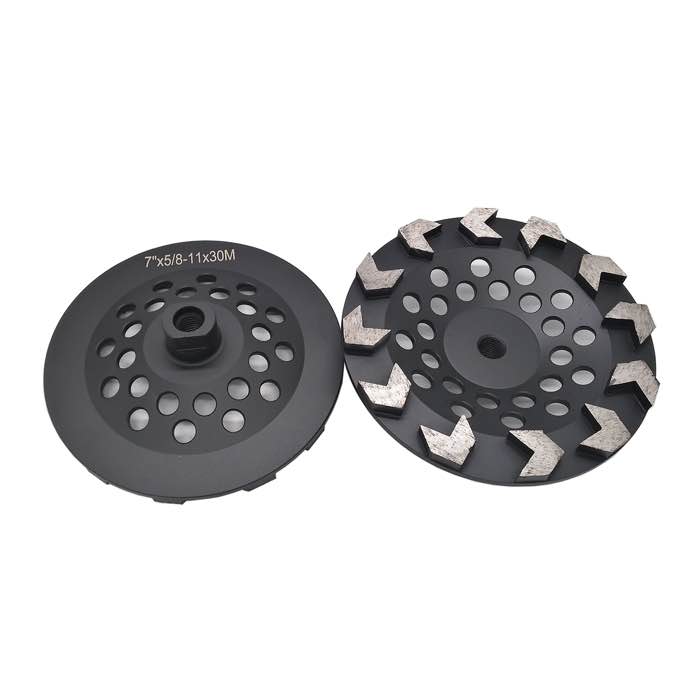
Run the machine at the RPM the tooling was designed for. arrow-segment cup wheel, usually printed on the pad or disc. Too slow makes metal bond rub and glaze; too fast overheats resin pads. On hand grinders, keep the disc speed high and the feed slow, using pressure only to keep the disc flat. A single-row cup wheel cuts fast at full RPM, while finer resin pads need a gentler touch. resin polishing pads and a slower machine speed to avoid burning.
Hard, dense concrete needs a slower feed and a coarser bond; soft concrete cuts quickly and can over-remove at a normal pace, so slow down. Surface coatings and glue call for PCD tooling at a steady pace rather than speed. Check the floor with a straightedge every few passes; if the flatness drifts, change the feed or overlap before the whole floor follows.
Slow and steady. Speed removes material less efficiently, leaves vibration marks, and makes the job inconsistent. A consistent moderate feed with correct overlap flattens the floor faster in practice.
If the floor shows bands or the disc skips across high spots instead of cutting, slow down and tighten the overlap. Vibrating passes and loud bouncing are signs of a feed that is too fast for the tooling.
Grind flat concrete at a steady 0.3 to 0.6 m/s feed with consistent overlap, correct RPM, and even pressure. Consistency across every pass is what keeps the floor level, so set the pace once and repeat it on every grit.
Written and reviewed by JOY TECH - an SGS & BV audited, CE/RoHS certified diamond tools manufacturer founded in 2004, exporting to 50+ countries.
Our factory and quality management system are audited by SGS and Bureau Veritas. Products meet CE/RoHS requirements and every piece is 100% inspected before packing.
Verified Certificates
