Average response time: under 24 hours
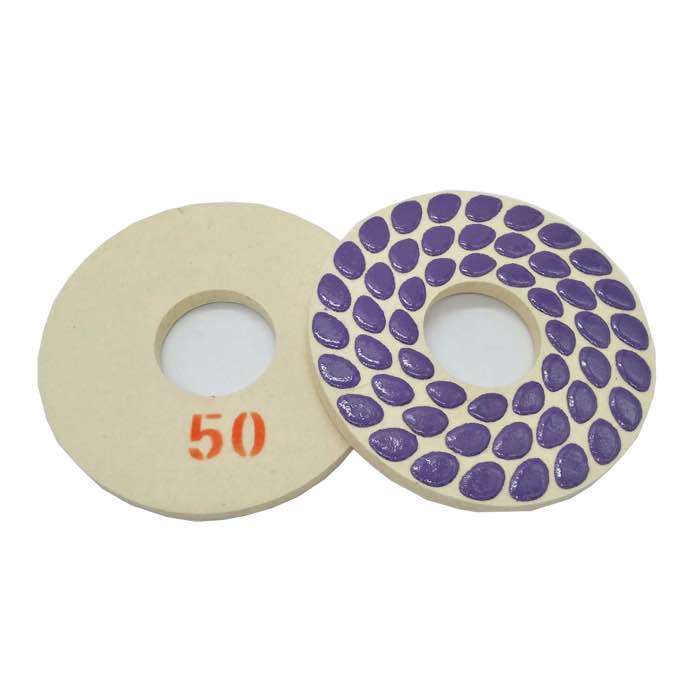
Dry polishing wool pads are soft, felt-like lamb's-wool or blended pads used on a high-speed floor burnisher to add the final 10-20 gloss units and a uniform wet-look sheen after diamond polishing is finished. They do not cut concrete - they burnish. Use them dry, at 1500-3000 RPM, on a 20 inch or 27 inch burnisher with 40-70 kg of weight, only after the floor has reached at least 1500 grit and the densifier has fully cured. Dry polishing wool pads (JOY-RFP-W1) sit in the final step of the process, after the last diamond resin pad, and they are the cheapest way to lift gloss before handover.
The two pad types are often confused because both sit on a burnisher, but they do completely different jobs.
| Diamond resin pad | Wool burnishing pad | |
|---|---|---|
| Cuts concrete? | Yes, removes scratches | No, only burnishes |
| Grit range | 50-3000 | No grit |
| Typical machine | Planetary grinder | High-speed burnisher |
| Wet or dry | Both | Dry only |
| Goal | Refine scratches | Raise and even out gloss |
If the floor still has visible scratches, a wool pad will hide nothing - it will just shine the scratches. Diamond resin pads such as the standard resin polishing pads (JOY-RFP-01) must finish the scratch removal first.
Insert wool burnishing at the very end, and only when:
For maintenance burnishing on existing polished floors, wool or blended pads such as the burnishing pads (JOY-RFP-BP2) are used weekly or monthly to restore the sheen that mopping and foot traffic flatten over time.
Mount the wool pad on the burnisher driver plate, lower the machine onto the floor before starting it, and walk the machine at a steady pace. Too fast and you get streaks; too slow and the pad heats up and glazes.
Contractors lose the gloss war in predictable ways: using a wool pad on a floor that still needs 800 grit work; burnishing before the densifier cures, which traps salts and causes white bloom; and reusing the same pad in a garage bay and a food area, which drags oil across the clean floor. Keep separate pads for dirty and clean zones.
A: Most polished concrete needs only dry burnishing. Some crews use a tiny amount of water-based gloss enhancer or guard, but read the sealer manufacturer's instructions - too much liquid turns the wet look into streaks.
A: Replace when the surface mats and stops throwing off lint, roughly every 4000 m2 of burnishing area. Flip the pad when one side flattens.
A: They are designed for polished, densified concrete. On epoxy or urethane coatings they add little and can overheat the coating - use a specific burnishing pad for coated floors instead.
A: Diamond-impregnated burnishing pads cost more upfront but last 10-20 times longer on large warehouses. Wool wins on small jobs and where the gloss needs a softer, warmer reflection.
Wool pads are the final polish, not the workhorse. Put diamond resin pads through the full grit ladder, let the densifier cure, then run the dry wool burnisher to even out the gloss and deliver the wet-look reflection buyers expect. JOY TECH stocks dry wool pads and burnishing pads for every common burnisher size, so your final step matches the quality of the grinding that came before.
Written and reviewed by JOY TECH - an SGS & BV audited, CE/RoHS certified diamond tools manufacturer founded in 2004, exporting to 50+ countries.
Our factory and quality management system are audited by SGS and Bureau Veritas. Products meet CE/RoHS requirements and every piece is 100% inspected before packing.
Verified Certificates
