Average response time: under 24 hours
Blotchy or hazy densifier application is almost always a surface-prep problem, not a product problem. The slab absorbed densifier unevenly because the 150-grit mechanical profile was inconsistent, water was left pooling, or old cure residue survived. Fix it by abrasively re-opening the affected zone with a 30/40 or 60/80 metal-bond pass, re-sweeping, and re-applying densifier in thin, wet-on-wet coats. If the haze is white and chalky, you overdiluted or over-sprayed; strip it with a neutral cleaner and re-apply at the manufacturer's rate (typically 4–8 m²/L).
| Symptom | Likely cause | Fix |
|---|---|---|
| White powdery patches, rubs off | Over-application / overdilution | Neutral wash, re-apply thin |
| Dark blotches, hard wipe | Cure residue under densifier | Re-grind 60/80, re-densify |
| Haze only in walk lanes | Dirty pad / shoe traffic before cure | Burnish with wool pad, then re-polish 800 |
| Cloudy after 1500 grit | Densifier not fully cured when polished | Re-grind 300→1500, wait full cure |
| Uneven gloss across slab | Uneven 150-grit profile | Re-grind 150 across whole slab |
Densifier relies on capillary absorption into the paste. If the surface profile varies — say, walk-behind left a 60-grit ridge next to a 150-grit flat — the densifier soaks in faster on the rougher zone. The result is a "blotch" that becomes visible at 800 grit. Water pooling during application makes it worse: pooled densifier dries to a white crystalline film.
A: A wool-pad burnish improves surface haze but does not fix uneven penetration. If the blotch is in the paste, re-grinding is the only permanent fix.
Minimum 2–4 hours at 20 °C. Polishing too early traps unreacted densifier and causes cloudy finish at 1500 grit.
Only in the under-absorbed zones. Re-applying densifier to those patches restores hardness; the over-absorbed white patches are inert and harmless after cleaning.
A: No — mild acid removes densifier film and forces a full re-grind. Neutral wash plus targeted re-grind is faster and cleaner.
If blotches cover more than 20 % of the slab, patching looks obviously different. In that case, strip the whole slab back to 60/80 metal, re-profile uniformly, and re-apply densifier once across the entire floor. It costs more than a patch job but produces a uniform finish that the customer will accept. Trying to patch a blotchy floor in showroom or retail applications usually ends in a callback.
Use a pump-up sprayer with a flat-fan nozzle set at 2–3 bar. Walk at a steady pace, overlap passes by 50 %, and keep the spray 30 cm above the floor. A cone nozzle or hand-pour produces puddles; a pressure washer-style jet produces uneven streaks. Test the sprayer on a piece of cardboard first — the pattern should be a uniform rectangle with no heavy center.
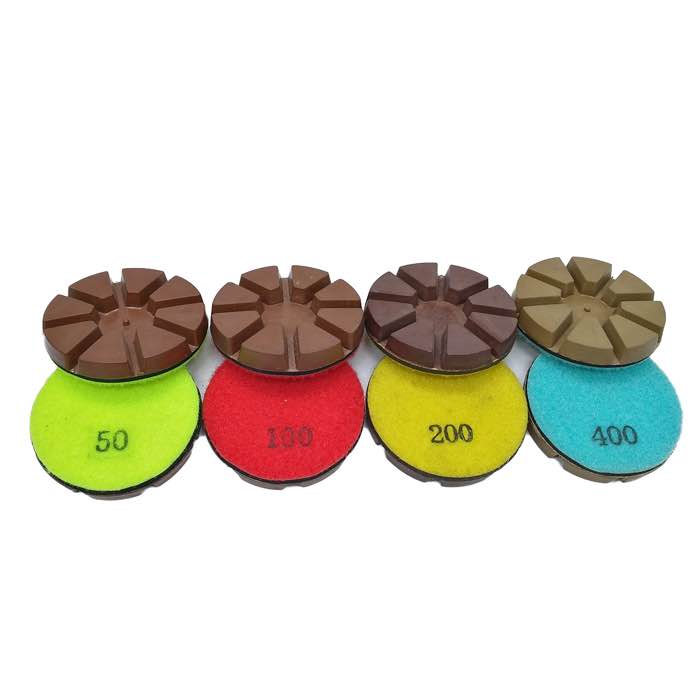
Blotchy densifier is a process error, not a lost floor. Diagnose the symptom, neutral-wash, re-open the affected zone, and re-apply thin. For the transition from re-grind back to high sheen, copper-bond hybrid transitional pads cut the scratch-out time in half and leave a uniform gloss.
Written and reviewed by JOY TECH - an SGS & BV audited, CE/RoHS certified diamond tools manufacturer founded in 2004, exporting to 50+ countries.
Our factory and quality management system are audited by SGS and Bureau Veritas. Products meet CE/RoHS requirements and every piece is 100% inspected before packing.
Verified Certificates
