Average response time: under 24 hours
Kitchen floors are not high-gloss showrooms. A practical commercial kitchen finish stops at 200–400 grit honed (DCOF 0.45–0.55 wet), uses a lithium or sodium densifier (not acrylic sealer), and gets a broom-finish or anti-slip additive pass in fry, wash and prep zones. Plan on grinding 3–5 mm around every floor drain by hand with an edge grinder — walk-behind machines cannot reach within 30 cm of a drain without spilling slurry into it. Budget 30–45 m²/hour production on a retrofit kitchen with equipment still in place.
These conditions favor mechanical densification and a non-film finish over high gloss.
| Step | Tooling | Goal |
|---|---|---|
| 1 | 30/40 metal bond | Open surface, remove old epoxy/tile adhesive |
| 2 | 60/80 metal bond | Remove 30-grit scratches |
| 3 | 150 hybrid/resin | Prep for densifier |
| 4 | Lithium densifier | Harden paste, chemical resistance |
| 5 | 200 or 400 resin pad | Honed finish, not mirror gloss |
| 6 (optional) | Broom texture pass or anti-slip broadcast | DCOF ≥ 0.45 wet in wet zones |
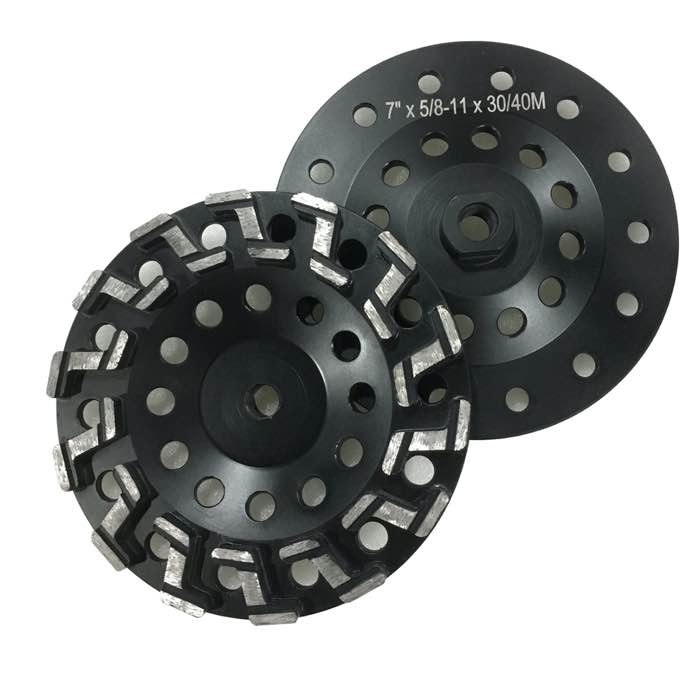
A S-segment cup wheel on an angle grinder is the standard tool for drain edges and equipment feet — aggressive enough to cut through old grease-encrusted paste without chipping adjacent tile or steel trim.
Acrylic or polyurethane "coatings" fail in kitchens within 12–18 months because grease under the film delaminates it. Lithium or sodium-silicate densifiers react chemically with the paste to form calcium-silicate-hydrate in the top 1–3 mm — they cannot peel and they resist degreasers. Coverage rate on a properly opened slab is 4–6 m²/L. Apply twice: first coat until the slab stops absorbing, second coat 30 min later.
Most US, EU and Middle East food codes require: non-porous surface (sealed by densifier), easily cleanable, and slip-resistant in wet zones. A 400-grit densified honed floor passes in nearly every jurisdiction. A 3000-grit mirror polish often fails wet DCOF testing. Specify the honed finish on the bid sheet to avoid a re-grind after inspection.
A: Technically yes, but practically no. Grease film on a 3000-grit surface becomes invisible until someone slips. Stick to 200–400 grit.
A: Mechanically densified kitchen floors typically last 8–15 years. A burnish once or twice a year with a 27-inch burnishing pad restores sheen without adding sealer.
Epoxy is cheaper up front but peels under grease within 2–4 years. Polished/densified concrete has a 10+ year service life and lower lifecycle cost.
A: Grinding is loud, dusty and wet — no. Book the floor during a shutdown, usually 3–5 days for a 200 m² kitchen.
For a 200 m² commercial kitchen in retrofit, expect: grinding and densifier €35–55/m², joint fill €15–25/m (linear), drain-edge hand work €200–400 per drain, and anti-slip broadcast in wet zones €8–12/m². Most restaurant groups budget €50–70/m² all-in. Lifecycle cost over 10 years is roughly half that of an epoxy system once recoat cycles are included.
If the customer cannot move the stoves, fryers or prep tables, plan hand-grinding under equipment feet with a double-row cup wheel on a 125 mm angle grinder. Mark each equipment foot, cut 5 mm around it, and use a small orbital sander for the last 10 cm. The floor will not be perfectly continuous under equipment, but it will clean properly and pass inspection.
Kitchen grinding is a food-safe, slip-resistant, non-film finish job. Open with 30/40, densify at 150 grit, stop at 200–400, and hand-finish every drain edge. For drain work and equipment feet, keep a set of S-segment cup wheels on the truck — they pay for themselves on the first retrofit.
Written and reviewed by JOY TECH - an SGS & BV audited, CE/RoHS certified diamond tools manufacturer founded in 2004, exporting to 50+ countries.
Our factory and quality management system are audited by SGS and Bureau Veritas. Products meet CE/RoHS requirements and every piece is 100% inspected before packing.
Verified Certificates
