Average response time: under 24 hours
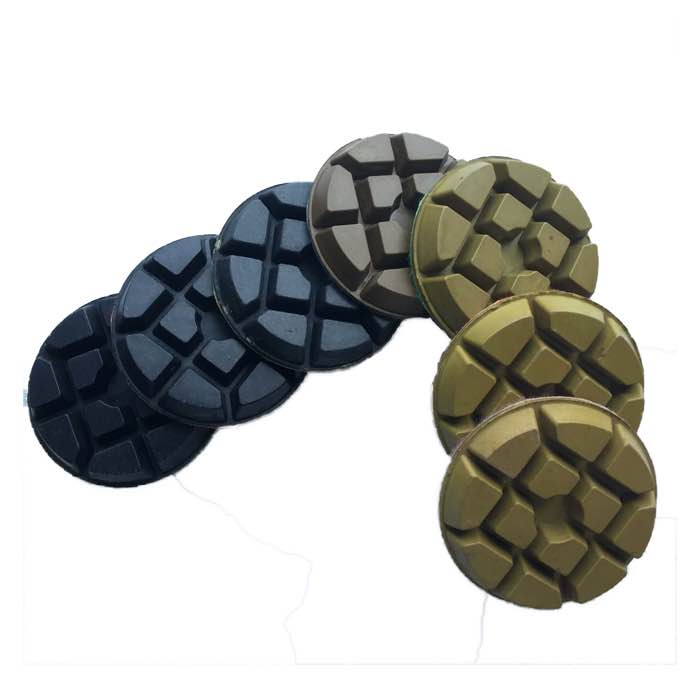
There is no fixed clock time per grit level - the correct rule is to keep polishing until the scratch pattern from the previous grit is 100% gone, then step up. On a typical residential or light commercial slab, that works out to roughly 2-3 overlapping passes per grit, about 3-8 minutes per square metre at each level, with the rough grinding stages (50-200 grit) taking the longest and the final resin stages (800-3000 grit) moving fastest. Never move up by the clock alone: run your hand across the floor, wipe a test strip dry, and if you can still see the previous grit scratches, stay put. Indicatively, a full wet sequence from 50 to 3000 grit on a 50 m2 floor takes most crews 6-10 hours of machine time, including drying and inspection stops.
Before quoting time per grit, know the variables that actually drive it. Two jobs with the same slab can differ by a factor of two:
Treat the times below as reference ranges for a standard 17-inch single-disc planetary machine on normal 3,000-4,000 PSI residential concrete; adjust by machine power and floor condition.
| Grit | What it does | Typical time per m2 (per grit) | Sign it is time to step up |
|---|---|---|---|
| 50 | Opens the slab, removes laitance, trowel marks and tooling lines | 4-8 min (usually 2-3 passes) | Uniform deep scratch pattern across the whole floor; no soft cream left |
| 100 | Refines the rough grind, starts flattening the floor | 3-6 min | 50-grit scratches fully gone; no low spots catching the light |
| 200 | Honing start, grinds out the last deep scratches | 2-5 min | Floor reads a consistent matte grey; no previous-grit marks visible |
| 400 | Standard honing, the salt-and-pepper stage | 2-4 min | Even matte finish, uniform aggregate exposure |
| 800 | High honing, first visible reflection | 1.5-3 min | Haze clears into a faint but even sheen |
| 1500 | Resin polishing, builds satin gloss | 1-2.5 min | Consistent satin gloss; swirl marks from 800 are gone |
| 3000 | Final gloss stage, depth of reflection | 1-2 min | Sharp, even reflection of lights; no cloudy patches |
These ranges assume fresh, matched resin pads and steady overlapping passes. Diamond Resin Polishing Pads for Concrete Terrazzo Floor (JOY-RFP-01) keep the later stages consistent because every grit in the line shares the same bond and diamond concentration - the pad set, not your arm, controls the time.
The clock is a planning tool; the scratch pattern is the decision tool. Three checks take about two minutes and end most debates:
Moved up too early and you can tell immediately: the next stage takes three times as long and leaves a uniform swirl that never fully disappears. On rough-to-honest transitions between metal-bond grinding and resin polishing, crews often add a Copper Bond Diamond Transitional Polishing Pad (JOY-RFP-C2) at 150-300 grit to bridge the gap - it shortens the 200-to-400 recovery that is the most common time sink on real jobsites.
Most wasted hours on a polish job come from process, not from the grits themselves:
For tight corners and stair nosings, 8 Triangles Diamond Resin Floor Polishing Pads (JOY-RFP-03) let the edge crew run the full 50-to-3000 wet sequence on the machine exact grit schedule instead of hand-faking a match at the end.
A: Roughly 2-3 overlapping passes per grit, or about 3-8 minutes per m2 depending on the stage and your machine. Rough stages (50-200 grit) take the longest; finishing stages (800-3000 grit) move fastest. Always finish by scratch pattern, not by clock.
A: Rinse and squeegee a test strip dry, then look at it from a grazing angle. If no scratches from the previous grit are visible, you are ready. If they show, keep the same grit for another pass or two.
A: Not on wet polishing. Skipping 200 or 400 grit saves about 10 minutes but almost always costs 30-60 minutes of correction at the 800-1500 stage, because the inherited scratch pattern will not polish out.
A: Most likely worn pads, harder concrete, or a machine losing weight or pressure on the head. Check pad freshness first - it is responsible for the majority of these surprises.
A: Per pass, wet cutting is slightly slower, but it produces a cleaner scratch pattern and avoids burnishing mistakes, so the full 50-to-3000 sequence usually finishes in comparable time with a better final gloss.
Budget the grit sequence by passes and scratch patterns, not by minutes: 2-3 passes per level, 3-8 minutes per m2 on the rough stages and 1-3 minutes on the resin stages, stepping up only when the floor wipes clean of previous-grit marks. The crews who finish faster are not rushing grits - they are running fresh pads, consistent overlaps and the full sequence in order. If your current pad set keeps dragging the 800-3000 stages, compare the time saved with a matched resin polishing pad set (JOY-RFP-01) before you blame the machine or the floor.
Written and reviewed by JOY TECH - an SGS & BV audited, CE/RoHS certified diamond tools manufacturer founded in 2004, exporting to 50+ countries.
Our factory and quality management system are audited by SGS and Bureau Veritas. Products meet CE/RoHS requirements and every piece is 100% inspected before packing.
Verified Certificates
