Average response time: under 24 hours
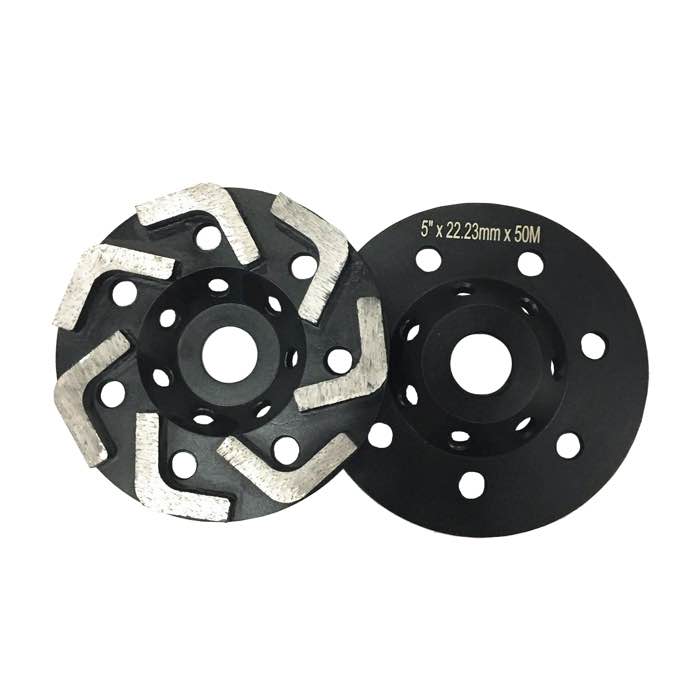
To grind concrete in tight corners, edges and around pipes that a big floor grinder cannot reach, use an angle grinder fitted with a 5 in diamond cup wheel for wall edges and the 5-10 cm strip along walls, a dedicated hand-held concrete edger for long walls, and a small 4 in hand grinder with a small cup wheel around pipes and columns. Match the grit sequence exactly to the main floor grinder so the scratch pattern blends invisibly.
A 25-30 in floor grinder leaves a 5-10 cm uncut strip along every wall, around every column, and beside every pipe penetration. On a polished floor that strip shows as a dull band unless you hand-grind it to the same grit as the center. Skipping edges is the number one reason a polished floor looks done in the middle but rough around the walls.
| Location | Tool | Tooling |
|---|---|---|
| Wall edges (5-10 cm strip) | Angle grinder 125/180 mm | Diamond cup wheel |
| Long straight walls | Hand-held edger | Small trapezoid puck |
| Inside corners (90 deg) | 4 in angle grinder | Small cup wheel, half-loaded |
| Around pipes / columns | 4 in hand grinder | Small triangle puck or cup wheel |
| Under cabinets / equipment pads | Variable-speed hand grinder | 3 in cup wheel with dust shroud |
A reliable workhorse is a 5 in variable-speed angle grinder fitted with a 5 in L Segment Diamond Grinding Cup Wheel (JOY-CW-L) — it cuts fast on concrete and leaves a scratch pattern that blends with 30/40# floor tooling. For softer concrete or finer scratch control, a Diamond Single Row Cup Wheel (JOY-CW-SR) gives a cleaner finish, while a Diamond Grinding Cup Wheel with 6 Round Segments (JOY-CW-R6) handles aggressive stock removal along formwork lines.
This is the rule most crews get wrong. If the main floor passes through 16# to 30/40# to 60/80# to 120/150# to resin 50# to 100# to 200#, your hand tools must follow the exact same grit ladder. If the big floor is at 60/80# but you only hand-grind the edge once at 60/80#, the edge will never blend. Always start edges at the same grit as the current main-floor pass.
Hand angle grinders throw silica dust directly at the operator's chest and face. Always use a shroud-equipped angle grinder connected to a HEPA vacuum. Open shroud-less grinding without a P100 respirator on enclosed concrete is a guaranteed OSHA citation and a real silicosis risk.
A: Yes, but use a variable-speed model (5,000-10,000 RPM) with a diamond cup wheel. High-speed die grinders burn the bond and glaze the wheel fast.
A: Typically 5-10 cm, depending on shroud design. Plan to hand-grind that strip on every single job.
A: Use the same grit sequence, feather the boundary by 10-15 cm, and run the floor grinder over the overlap at the final metal-bond pass to even out scratch depth.
A: 4 in (100 mm) for inside corners and around pipes; 5 in (125 mm) for open wall edges. A 7 in wheel is too clumsy in corners.
Edges, corners and pipe penetrations are the finishing touch that separates an amateur polish from a professional one. Match the grit, use the right cup wheel, and never skip the HEPA vacuum. JOY TECH (Xiamen) supplies diamond cup wheels in 4-9 in for every common angle grinder. For tooling matched to your machine and concrete, email [email protected].
Written and reviewed by JOY TECH - an SGS & BV audited, CE/RoHS certified diamond tools manufacturer founded in 2004, exporting to 50+ countries.
Our factory and quality management system are audited by SGS and Bureau Veritas. Products meet CE/RoHS requirements and every piece is 100% inspected before packing.
Verified Certificates
