Average response time: under 24 hours
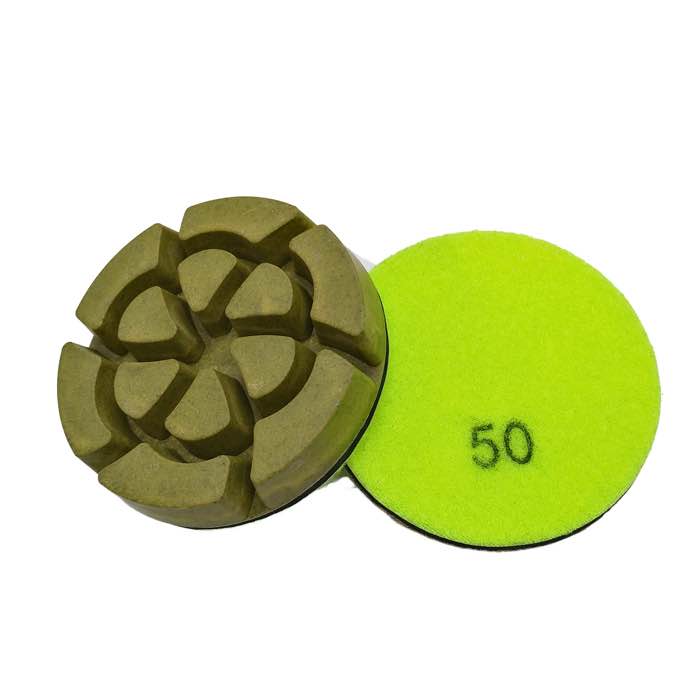
Yes, you can polish a concrete countertop by hand. A variable-speed handheld polisher (1000–4000 RPM) with a 3-inch diamond resin pad set is the right tool for the job. Start at 50 or 100 grit, then step through 200, 400, 800, 1500 and finish at 3000 grit. Work in small 0.5 m² sections, keep the pad flat, and never skip more than one grit size. For tight edges and corners, switch to hand-held sanding blocks and flexible pads.
Our smallest-format consumables are built exactly for this kind of job: browse the 3'' Diamond Resin Floor Polishing Pads (JOY-RFP-05) and the 3'' 15mm Thickness Diamond Dry Polishing Pads (JOY-RFP-06) for dry or wet use.
A countertop is a small, horizontal, benchtop object—you do not need a 70 kg planetary floor grinder. A handheld rotary polisher (a variable-speed angle grinder or a dedicated concrete polishing kit) gives you the control and reach a floor machine cannot. The trade-off is effort: a full kitchen countertop can take 4–8 hours of work across the full grit sequence.
Resin-bond diamond pads are the only choice. Metal-bond segments are too aggressive and will dig into a thin countertop slab. For hand work, 3-inch (75 mm) hook-and-loop pads are the standard because they fit most handheld polishers.
| Grit | Purpose | Notes |
|---|---|---|
| 50 / 100 | Remove trowel marks, form oil, coarse scratches | Skip if the countertop is already honed |
| 200 / 400 | Grind out previous grit scratches | Most time-consuming step |
| 800 | Satin / low sheen | Stop here for a matte look |
| 1500 | Near-polish | Required before 3000 |
| 3000 | High gloss | Final step; use light pressure |
If you already own a 5-inch angle grinder and prefer a larger face, the 5''/125mm Diamond Resin Polishing Pads (JOY-RFP-S1) covers surface faster, but edges become harder to control.
Wet polishing suppresses silica dust, extends pad life and produces a clearer scratch pattern. In a shop, it is almost always the better choice. Dry polishing is acceptable for 50–200 grit on a countertop already installed in a home where water cannot be contained, but you must use a HEPA-rated dust extractor. Do not switch from wet to dry halfway through a grit step—finish each grit under one condition.
A: Yes, but choose a variable-speed angle grinder. Fixed-speed 10,000+ RPM grinders are too fast and will glaze the pad. Look for 1000–4000 RPM and a 5/8"-11 or M14 thread.
A: About 5–15 square meters per pad set, depending on concrete hardness. Hard concrete wears pads faster; soft concrete loads them faster. Replace when the diamond layer is polished smooth or the pad vibrates.
A: Pre-cast countertops are usually made with a low water-cement ratio and already dense, so a densifier is optional. For a cast-in-place pour, a lithium densifier before 800 grit improves shine and durability.
A: Yes, with sanding blocks and wet/dry diamond hand pads, but the process is 5–10 times slower and very hard to do evenly on a large surface. A handheld polisher is strongly recommended.
Hand polishing a concrete countertop is a realistic DIY or small-shop job once you have the right 3-inch resin pad set and a variable-speed polisher. Stick to the grit sequence, keep the pad flat, and finish at 3000 grit for a durable, food-safe shine. Need help choosing the right pad grit for your specific mix? Email us at [email protected]—JOY TECH (Xiamen) manufactures the full JOY-RFP range and ships worldwide.
Written and reviewed by JOY TECH - an SGS & BV audited, CE/RoHS certified diamond tools manufacturer founded in 2004, exporting to 50+ countries.
Our factory and quality management system are audited by SGS and Bureau Veritas. Products meet CE/RoHS requirements and every piece is 100% inspected before packing.
Verified Certificates
