Average response time: under 24 hours
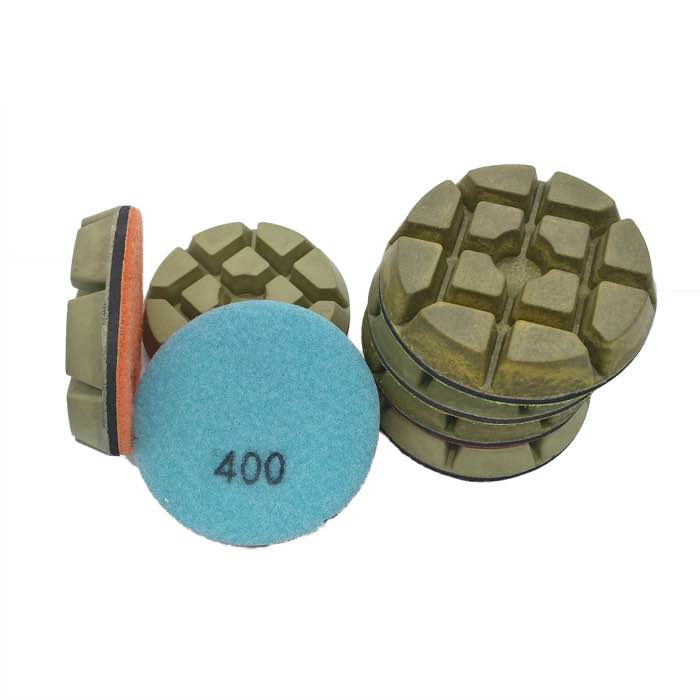
Polish a concrete countertop wet: after a minimum 7-day cure, grind under a constant flow of water through diamond resin pads starting at 50 or 100 grit and stepping up to 200, 400, 800, 1500, and 3000 grit on a variable-speed angle grinder with a 100 mm backing pad, running at 2500 to 4500 RPM. Stop between grits, wash off the slurry, inspect for pinholes, fill with a cement paste if needed, densify after the 400-grit step, and finish with a penetrating sealer and a topical wax. Keep the pad wet at all times; dry grinding will burn the resin and leave swirl marks.
Concrete countertops are small, horizontal surfaces close to cabinets, walls, and plumbing. Wet grinding keeps dust to zero, washes the swarf away from the diamond pad so it cuts cleanly, and keeps the pad cool enough that the resin bond does not glaze over. Wet grinding also gives a flatter, more uniform scratch pattern than dry grinding on a vertical-edge countertop, because the water lubricates the pad and lets it float over pinholes rather than digging into them.
Demold the countertop at 24 to 48 hours, then let it cure a minimum of 7 days (ideally 14) under plastic or misting. Polishing too early opens wet cement paste and causes blotchy discoloration later.
With water flowing, pass the grinder across the flat top in overlapping 30 cm strokes. Keep the pad flat; tilt digs grooves. The goal at this grit is to remove mold release, trowel marks, and high spots, not to texture the surface. Expect a uniform matte gray by the end of 100 grit.
Wipe the surface dry and look for bugholes, air voids, and pinholes. Fill them with a thin slurry of the same cement used in the mix (or a color-matched epoxy paste), trowel it in, let it cure, and grind it back flush at the next grit. Do this after 100 grit and again after 400 grit.
Move from 100 to 200 to 400 to 800 to 1500 to 3000 grit. Each step must fully remove the scratch pattern of the previous grit; if you still see 100-grit swirls at 400, back up. Wash the slurry off between every grit and inspect under raking light. Do not skip grits.
Once the surface is uniformly honed at 400 grit, dry the countertop, spray a lithium densifier, let it dwell 20 minutes, and buff off the excess. Wait 2 hours, then continue to 800, 1500, and 3000. The densifier hardens the paste so the final polish reads clearer and stays cleaner in use.
Edges are hardest because the grinder wants to round them over. Use a flexible edge pad or a hand-held diamond block on the bullnose, working the same grit ladder by hand. Keep the water flowing; edges heat up fast. Finish edges by hand at 3000 grit to avoid rounding the top corner.
After the countertop is fully dry (24 to 48 hours), apply a penetrating sealer per the manufacturer, then a topical wax or polyurethane topcoat if a food-safe finish is wanted. Reapply the wax once or twice a year. Use cutting boards and trivets; concrete is heat-resistant up to about 120 °C but will stain under prolonged wet contact.
Even a carefully polished countertop can chip if a heavy cast-iron pan is dropped on the front edge. Rinse the chip clean, let it dry, and pack a color-matched epoxy or cement-based repair paste into the missing notch with a plastic putty knife. Level it flush, let it cure fully, then hand-sand the spot with 400, 800, and 1500 grit resin pads under running water to blend the sheen. A small repair will read as a faint texture difference under angled light; that is normal and disappears after a few years of use.
After two or three years, the work zone directly behind the sink may look duller than the rest of the top. Strip the old wax with a neutral floor stripper, re-run the pad sequence from 400 up to 3000 on that local area, let it dry overnight, then reapply the sealer and a fresh coat of food-safe wax. Plan on half a day of work for a three-meter kitchen; the rest of the countertop does not need to be touched.
Wipe up coffee, wine, and citrus spills within the hour; concrete counters stain faster than polished floors because the surface area is small and spills sit in one place. Use cutting boards for knives; concrete is harder than steel and will dull blades quickly. Reapply the food-safe wax once or twice a year. Avoid abrasive scouring pads on the polished face; they leave micro-scratches that catch oil and turn gray. With normal care, a polished concrete countertop ages like worn leather, developing a soft patina rather than a worn-out look.
Written and reviewed by JOY TECH - an SGS & BV audited, CE/RoHS certified diamond tools manufacturer founded in 2004, exporting to 50+ countries.
Our factory and quality management system are audited by SGS and Bureau Veritas. Products meet CE/RoHS requirements and every piece is 100% inspected before packing.
Verified Certificates
