Average response time: under 24 hours
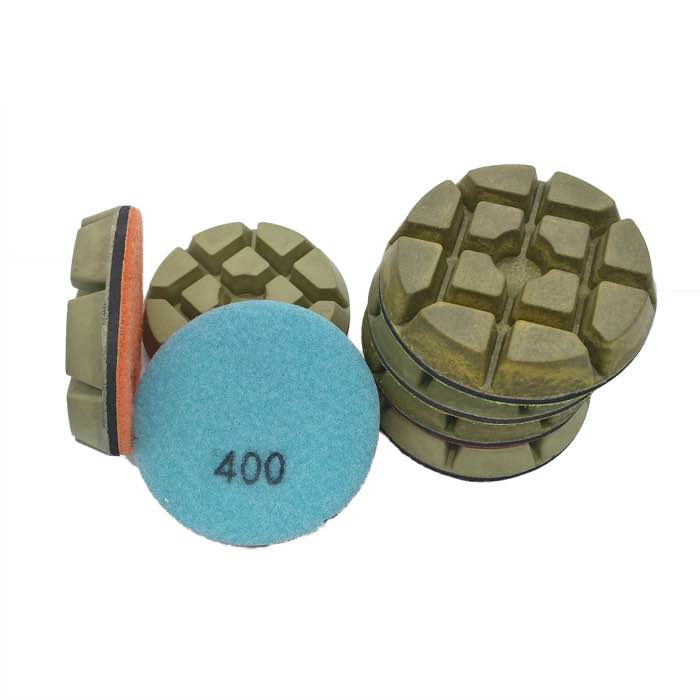
Polish edges and corners with a handheld variable-speed grinder or a dedicated concrete edge polisher fitted with diamond resin discs, running the same grit sequence as the main floor (typically 50 through 3000 grit) at 1500 to 4000 RPM, in overlapping 30 to 60 cm strips, and always matching the grit the rest of the slab is currently on. Finish the edge band within one grit step of the central floor so the sheen blends invisibly.
A 60 or 80 cm planetary grinder cannot reach within 20 to 30 cm of a wall, a column, a door frame, or a corner. That perimeter band has to be worked by hand. It is also the most visible band in a room: light from windows rakes across it, and any missed grit or burnished patch will show immediately. Done wrong, the edge band looks duller, hazier, or scratched than the center.
Use a variable-speed angle or plunge grinder with a 125 mm (5 inch) or 180 mm (7 inch) backing pad, rated at 1500 to 4000 RPM under load. Cheap fixed-speed grinders that spin at 10 000 RPM will burnish the resin pad instead of cutting, leaving a smeary haze. A purpose-built edge polisher with a 90-degree gear head and a fold-out dust port gives the best control along walls.
Use diamond resin polishing discs in the same grits as the floor machine: 50, 100, 200, 400, 800, 1500, and 3000. Metal-bond puck discs are used on edges if the perimeter needs level grinding before resin work begins. Keep a separate set of pads for edges so you do not contaminate the floor set with wall dust.
Fit a vacuum shroud with a brush skirt to the grinder and connect an industrial HEPA vacuum. Without it, silica dust from edge work will coat the whole room.
Before you start on the edge band, note which grit the floor crew is currently on. Your edge work must be within one grit step of that point. If the floor is on 800 grit, you should have already finished the edge at 400 grit and be moving to 800 yourself. Trying to jump the edge band to 3000 while the floor is still at 400 leaves a visible line.
If the slab has trowel marks, laitance, or uneven formwork lines along the wall, open the edge band with a metal-bond puck or a 50-grit resin disc. Hold the grinder flat, not tilted, and pass back and forth in 30 cm strips. Walk the whole perimeter once before moving to the next grit so the grinding depth is even.
For each grit, run the polisher in parallel strips along the wall, overlapping each strip by about a third. Keep the disc flat on the floor; tilting it digs a crescent groove that shows up under later high-gloss passes. On tight corners, tilt the grinder to use the edge of the disc, but limit tilt passes to a few seconds so you do not dig in.
Inside corners are the hardest. A standard round disc will leave a small triangular patch untouched at the very corner. Finish those patches by hand with a hand-held diamond polishing block or a small 50 mm triangular pad on a right-angle die grinder. Work the corner after the rest of the edge band is at the same grit so you do not leave fresh scratches in an already polished area.
Where the hand-polished edge band meets the machine-polished center, feather the last strip outward so the two grits blend. After the final 3000-grit pass, do a single light sweep across the transition with a white or maroon burnishing pad to remove any cross-scratches.
Wear a N95 or P100 respirator under the vacuum hood, safety glasses, hearing protection, and knee pads. Edge work is done on your hands and knees for hours; a padded knee board and a folding work stool save the body. Unplug the grinder before changing discs so the trigger cannot be bumped.
Most floor grinders leave a band of 20 to 30 cm around the perimeter that has to be hand-worked. Mark that band with masking tape before you start so the edge crew knows exactly where the machine work ends and hand work begins. On columns and built-in cabinets, the band widens; plan for an extra 15 cm of hand work around every obstacle. The narrower you can make the hand-worked band, the faster the job and the less chance of a visible line between machine and hand polishing.
Written and reviewed by JOY TECH - an SGS & BV audited, CE/RoHS certified diamond tools manufacturer founded in 2004, exporting to 50+ countries.
Our factory and quality management system are audited by SGS and Bureau Veritas. Products meet CE/RoHS requirements and every piece is 100% inspected before packing.
Verified Certificates
