Average response time: under 24 hours
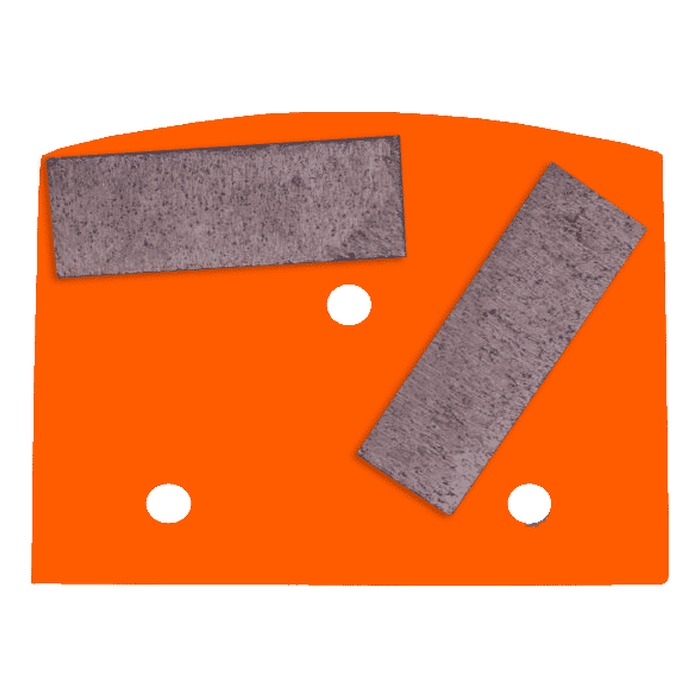
Polycrystalline diamond (PCD) tools remove the coating; diamond grinding blocks profile the concrete underneath. For epoxy, adhesive, paint or self-levelling topping on Brazilian floors, run one PCD pass at 1–3 mm depth, then a metal bond block in 16# or 30/40 to clean the residue and open the surface. Skipping the second pass is why so many jobs come back with a patchy, uneven finish.
A diamond segment grinds concrete, but it slides over a tough polymer coating and loads up instead of cutting. PCD is a different material: a sintered diamond compact with a flat, hard face that shears coatings rather than grinding them. That is why a PCD block removes a 2 mm epoxy layer in a couple of passes, where a metal bond block would polish the epoxy and burnish it.
Once the coating is gone, the concrete surface is scarred and uneven — PCD leaves shallow gouges by design. The following metal bond pass levels the scars and gives the resin steps a clean base. If you want to compare both approaches in detail, see PCD vs diamond grinding for coating removal.
| Coating | Typical thickness | Best first tool |
|---|---|---|
| Epóxi autonivelante (self-levelling epoxy) | 1.5–4 mm | PCD, 1/4 or 1/2 PCD |
| Epóxi de alta espessura / argamassa epóxi | 3–6 mm | Full PCD plus alloy bar |
| Adesivo de carpete / cola de PVC | 0.3–1.5 mm | PCD; small PCD where the layer is thin |
| Tinta epóxi ou poliuretano | 0.1–0.5 mm | PCD with small PCD, or coarse diamond block |
| Contrapiso autonivelante (self-levelling screed) | 2–10 mm | PCD + hard bond block |
| Resina / verniz de acabamento | 0.1 mm or less | Coarse diamond block, PCD only if it smears |
All trapezoid PCD tools below take M6, 9 mm or Diamatic three-hole plates, so they fit the universal heads that dominate the Brazilian market.
| Model | PCD configuration | Segment | Connection | Where it works best |
|---|---|---|---|---|
| JOY-TP-PCD1A1 | 1 full PCD + 1 alloy dot | — | M6 / 9 mm / Diamatic holes | Thick coatings, screed and epoxy toppings |
| JOY-TP-PCD2B1 | 2 × 1/4 PCD + 1 bar segment | 1 bar | M6 / 9 mm / Diamatic holes | General epoxy and adhesive removal with residual grinding |
| JOY-TP-PCD3R1 | 3 × 1/2 PCD + 1 round segment | 1 round | M6 / 9 mm / Diamatic holes | Hard, thick epoxy; less gouging on soft concrete |
| JOY-TP-PCD5 | 5 small PCD | — | M6 / 9 mm / Diamatic holes | Thin paint, varnish and glue layers |
| JOY-TPF-PCD2B1 | 2 × 1/4 PCD + 1 bar segment | 1 bar | Fast Change System | Quick-change heads, high-volume coating removal |
| JOY-CW-PCD6 | 6 × 1/4 PCD | — | 5/8"-11, M14, 22.23 mm, 16 mm | Hand grinder and edge work |
Two families cover most jobs: 1/4 PCD with an alloy or diamond segment for everyday coating removal, and full or 1/2 PCD for thick epoxy and self-levelling toppings. On soft concrete, three smaller PCD cut less deeply than one full PCD, which keeps the gouges shallow.
Run the PCD pass in straight lines at a steady feed, about 1–2 mm per pass on epoxy, and do not stop the head in one place: heat softens epoxy and the tool starts smearing instead of shearing. Then switch to a 16# or 30/40 metal bond block to remove residue and level the gouges, follow with 60/80, and only then move to transitional pads. On large industrial floors in São Paulo and Minas Gerais, this two-stage approach is what keeps the schedule predictable.
Epoxy and polyurethane dust is a health hazard, not ordinary concrete dust. Use a HEPA extraction unit rated for the grinder, keep the shroud sealed, and wear P2/P3 respiratory protection. Do not wet down epoxy dust to control it — it turns into a smear that clogs the shroud and hides the surface.
Only thin paint and varnish layers. On anything above roughly 0.5 mm, a metal bond block polishes the coating instead of removing it, and you spend more time and more blocks than a PCD pass would have cost.
Usually one, sometimes two on thick self-levelling toppings. Stop as soon as you see consistent concrete; a third pass only deepens the gouges.
Yes. Adhesive layers are thin and gummy, so use small or 1/4 PCD at a slow feed, then clean the residue with a 16# block before it re-bonds to the surface.
Tell us the coating type, the measured thickness, the concrete condition underneath and the machine model. We will match the PCD configuration and the follow-up block so one order covers both stages. Browse grinding and coating removal tools, or read which PCD shape suits thick coatings.
Written and reviewed by JOY TECH - an SGS & BV audited, CE/RoHS certified diamond tools manufacturer founded in 2004, exporting to 50+ countries.
Our factory and quality management system are audited by SGS and Bureau Veritas. Products meet CE/RoHS requirements and every piece is 100% inspected before packing.
Verified Certificates
