Average response time: under 24 hours
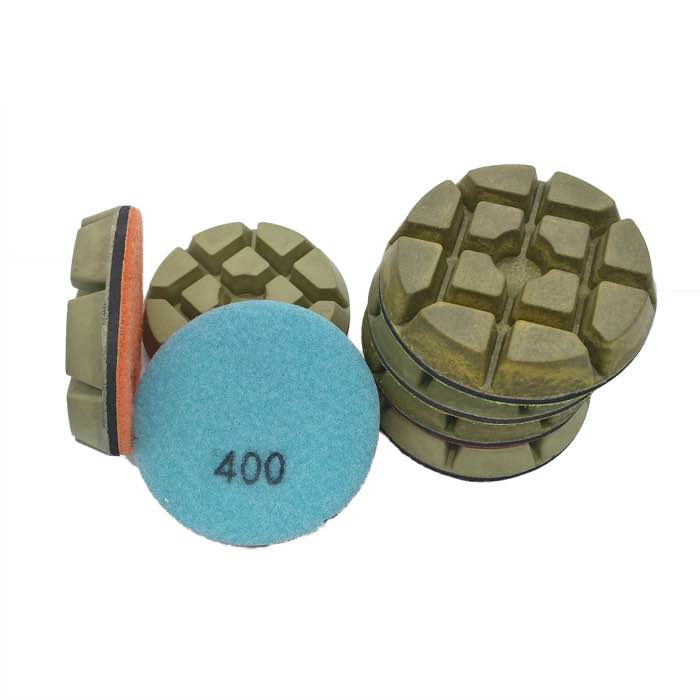
After grout removal, do not jump straight to resin polish. Re-open the slab with a 50 or 100 grit metal-bond pass to strip the remaining grout haze and fine scratches, then move through 200, 400, 800, 1500, and 3000 grit resin pads, densifying between the 200 and 400 steps. Skipping grits leaves a cloudy finish that no amount of burnishing will fix. Expect 6 to 8 passes per square meter and plan to re-polish the affected area rather than touch it up in random spots.
Grout is cementitious, and when you scrape or grind it off a polished slab you leave a film of fine cement dust embedded in the pores, plus micro-scratches from the removal tool. A buffing pad alone cannot cut through that film; it just smears it around. The slab looks dull, blotchy, and slightly hazy, especially under direct light. To recover the mirror finish you have to re-enter the mechanical polishing sequence.
Water spotting after grout work is a separate clue. If the patch darkens when wet and dries to a chalky look, the densifier film has been washed off in that zone. That means you are not just polishing over a scratch; you are rebuilding a hard, dense surface. Treat it as a fresh polishing job on a small patch, not a buff-out.
Run your hand across the patch in raking light. Fine swirls that disappear when wet usually lift with a 400-grit resin pass. Deep gouges from a scraper or grinder bite need a 50 or 100 metal-bond cut to flatten. Mark the worst spots; they will set your starting grit.
If the grout was laid recently, wait at least 7 days before grinding over it. Grinding fresh cement pulls material out and leaves a low spot. Test with a damp cloth: the area should not turn dark and stay wet for minutes.
Work in a logical ladder, one grit per pass, overlapping 30 percent. Do not skip grits; each one must remove the scratch pattern of the step before it. The JOY-RFP-01 resin polishing pads are the standard choice for the upper half of the ladder on medium-hard concrete.
On an existing polished slab that has already been densified, you may not need another coat. If the grout removal opened fresh pores, apply a light densifier after the 200-grit pass, let it react 2 to 4 hours, then continue. Do not densify after 400 grit; the surface is too closed and the product will sit on top and haze. Wipe off any densifier that beads on the surface within 15 minutes; it will not penetrate and will leave a white film that needs grinding out.
Jumping from 100 straight to 800 leaves the 100-grit scratches locked in. No later pass will remove them; the floor looks cloudy under light and you have to start over from 100. The time you save on one skipped grit is paid back threefold on rework.
Too much water dilutes the densifier and washes resin pad grit off before it cuts. Keep the floor just damp, and change pads once they load up with cement paste. Transitional copper-bond pads like JOY-RFP-C2 bridge the gap between metal and resin on hard, troweled surfaces.
A patch re-polished alone will never match the surrounding sheen. Feather the re-polished zone 30 to 60 cm beyond the grout line so the transition is invisible under walking light. Walk the boundary at an angle with a torch; if you can see the edge, keep feathering.
Walk the floor at dawn or dusk with the sun low. The gloss should be uniform, with no cloudy halos around the former grout area. If you can still see scratches in raking light, drop one grit lower and repeat the sequence. A properly restored polished floor reflects cleanly and matches the rest of the slab within one sheen level. If the gloss still looks flat after 3000, give the slab a dry burnish with a clean white pad under a high-speed burnisher at 1,500 to 2,000 rpm; that usually closes the last 5 percent of clarity without another diamond pass.
Written and reviewed by JOY TECH - an SGS & BV audited, CE/RoHS certified diamond tools manufacturer founded in 2004, exporting to 50+ countries.
Our factory and quality management system are audited by SGS and Bureau Veritas. Products meet CE/RoHS requirements and every piece is 100% inspected before packing.
Verified Certificates
