Average response time: under 24 hours
Polished concrete color varies because cement batch, aggregate source, water-cement ratio, trowel timing, and curing humidity all change the finished shade. You cannot fully control it, but you can manage it: specify a consistent cement and aggregate source, polish to a defined aggregate exposure level, use integral color or dye to unify the tone, and build a mockup before the floor goes down. Expect 10 to 15 percent natural tone variation across a large slab; anything more is a placement problem, not a polishing problem.
Concrete is not paint. It is a mixture of cement, sand, stone, water, and air voids. When you polish through the top paste, you expose whatever was in that particular patch. A patch with more sand reads lighter; a patch with more cement paste reads darker. A patch troweled early reads darker and denser; a patch troweled late reads lighter and more porous. These differences are invisible before polishing and become obvious under the resin steps.
Most disputes about color happen on day one, when the sun hits the new floor. The contractor points at the mockup; the client points at the patch by the window. Both are right, because polished concrete is a natural material, not a coating. Setting expectations before the pour is half the job.
Portland cement color shifts from lot to lot by 5 to 10 percent. One truck poured from a different silo will read slightly different. Specify a single cement supplier and ask the ready-mix plant to flag batch changes.
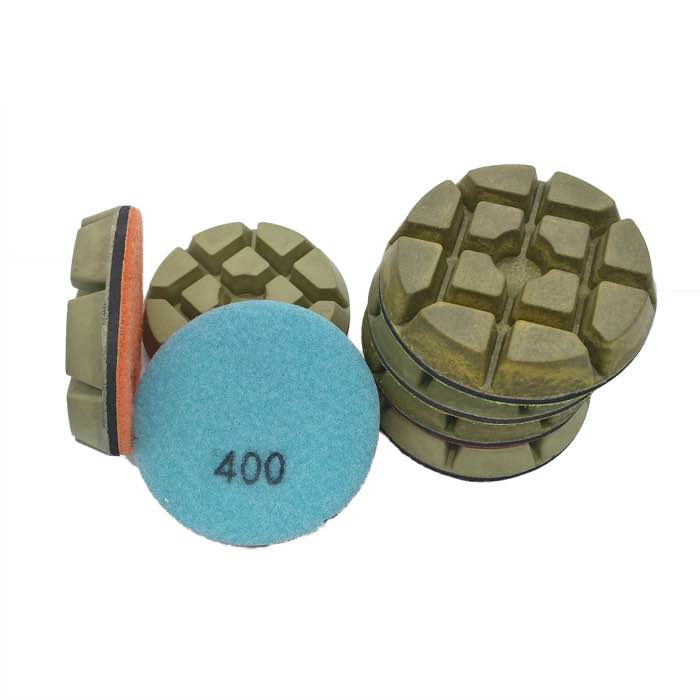
The more you grind, the more aggregate shows up. A floor ground to 50 grit exposes sand; a floor ground to 15 grit exposes river rock. Match the exposure level across the whole slab. The JOY-RFP-03 triangular resin pads give consistent pressure on uneven slabs, so exposure stays even across a large floor.
Workers splash extra water on the slab to make finishing easier. That extra water weakens the top paste and lightens the patch. Inspect the pour; forbid water on the slab. A single bucket tossed on a hot afternoon can create a 3 m pale patch that no later polishing hides.
Slabs cured under plastic cure darker and more uniform. Slabs cured in dry air cure lighter and blotchier. Wet-cure the slab for 7 days before polishing. Curing compound spray must be removed before densifier, or the floor polishes to a patchy sheen.
Integral color is mixed into the truck and colors the whole slab consistently. Dye is applied after polishing and can look uneven if the slab porosity varies. For a uniform look, use integral color; for a mottled, artistic look, use acid stain or dye.
A well-poured slab shows 10 to 15 percent tone variation across its area. That is expected and looks natural. Variation beyond 25 percent means a placement error: a bad cold joint, a wet patch, a trowel timing difference, or a different cement truck. Polishing cannot fix those; you can only hide them with dye or grind them back.
Dense, even polishing with consistent pad pressure minimizes visible variation. The JOY-RFP-01 resin pads cut evenly across soft and hard patches, reducing contrast between zones. After polishing, apply a translucent dye or stain to unify the tone; choose a semi-opaque dye so natural aggregate still shows through. Build the mockup first to test the dye load on the actual slab. On large floors, divide the pour into bays and record the cement batch for each bay so you can predict where variation will appear.
No. Polishing does not change the underlying tone; it just reveals it more clearly. If a patch is too dark, more grinding will make it lighter only by exposing more aggregate, which changes the exposure level and breaks uniformity.
A topical sealer darkens the whole floor equally; it does not blend patches. It also wears off and needs reapplication. Densifier is invisible; dye is the only product that actually shifts tone.
Most color variation is set at the pour. The polishing crew can make it worse by inconsistent pad pressure, but they cannot fix a slab poured with three different cement batches. For a pre-pour color control consultation, reach contact us.
Polished concrete color variation is part of the material character. Specify one cement source, forbid on-site water, wet-cure for 7 days, match aggregate exposure, and use dye or integral color when uniformity matters. Build a mockup the client signs off on. Accept the natural variation; trying to eliminate it entirely costs more than the floor is worth.
Written and reviewed by JOY TECH - an SGS & BV audited, CE/RoHS certified diamond tools manufacturer founded in 2004, exporting to 50+ countries.
Our factory and quality management system are audited by SGS and Bureau Veritas. Products meet CE/RoHS requirements and every piece is 100% inspected before packing.
Verified Certificates
