Average response time: under 24 hours
For polished concrete joints, polyurea fills are the better default: they cure in 1 to 2 hours, stay slightly flexible, and resist forklift impact without spalling. Epoxy fills are cheaper, harder, and polish to a crisp line, but they cure overnight and can crack if the joint moves. Pick polyurea for busy warehouses, distribution centers, and slabs subject to vibration; pick epoxy for retail showrooms, garages, and light-traffic floors where color match and mirror polish matter more than impact resistance. Fill joints after metal-bond grinding and before resin polishing, not after the floor is finished.
Unfilled control joints collect dirt, trap water, and chip at the edges under cart wheels. On a polished floor, the joint is also a visual break that draws the eye. Filling it flush with a semi-rigid material protects the edge and lets the polish run uninterrupted. Leave it empty and the joint edge chips within a year; once chipped, it cannot be polished back.
Two-part epoxy is a rigid structural filler that cures hard, usually to an 80 to 90 Shore D hardness. It can be colored to match the slab, troweled flush, and diamond polished along with the rest of the floor. The result is a near-invisible joint line that looks like a single monolithic slab.
Epoxy cures slowly: 8 to 24 hours before you can grind it. It is also rigid. If the slab moves, curls, or is still settling, epoxy cracks or delaminates because it cannot flex with the joint. It is best on cured, stable slabs with light traffic.
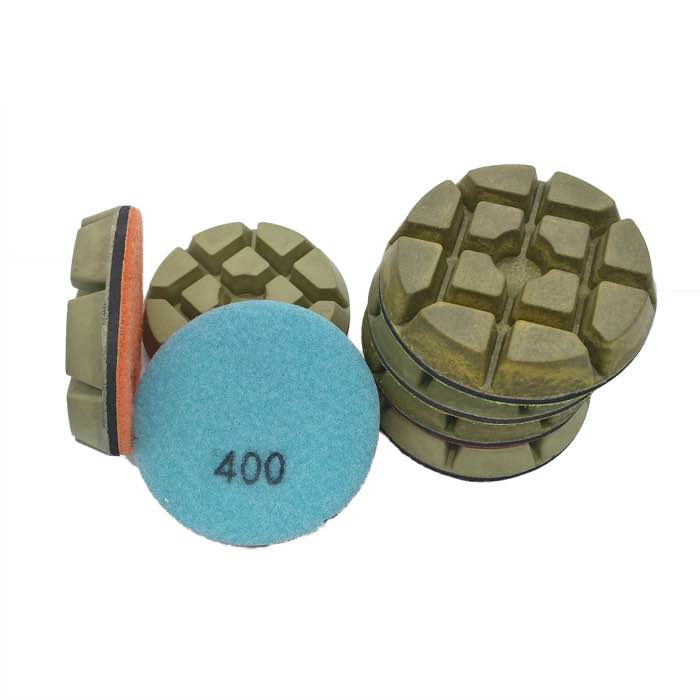
Two-part polyurea is an elastomeric filler that cures in 60 to 120 minutes to a Shore A 80 to 95 hardness — firm but slightly flexible. It can be ground and polished the same day. The JOY-RFP-01 resin polishing pads cut polyurea as cleanly as epoxy once it is cured, so the polishing step does not change.
Polyurea costs more per linear meter and is harder to color match because it cures fast. But it flexes with joint movement, survives forklift turns, and will not spall at the edge. For active warehouses it is the safer choice.
Warehouses with forklift traffic, slab-on-grade buildings less than 2 years old, exterior-adjacent joints that expand and contract, and projects on a tight schedule where you cannot wait overnight. Pair the fill with JOY-RFP-02 resin pads for a consistent grind through the joint and the slab.
Retail showrooms, residential garages, museums, and slabs that are fully cured and stable. Color-match epoxy to a sample of the wet-ground concrete so the joint disappears under the polish. Copper-bond transitional pads like JOY-RFP-C2 smooth the transition between the epoxy and the slab during the first resin step.
Clean the joint with a vacuum saw or an air lance. Any dust left under the filler weakens the bond. Undercut the joint with a diamond blade to a 6 mm wide by 10 mm deep reservoir so the filler has a mechanical lock. Backer rod sits at the bottom so the filler does not three-bond. Fill flush, let cure, then grind. Skip prep and even the best filler pops out within months.
Most specifiers default to polyurea because it is faster and more forgiving. Specify epoxy when the customer wants the flattest possible joint line and the traffic is light. Either way, fill the joint after metal grinding, before densifier, and grind it flush with the slab. A well-filled joint is invisible under polish; a poorly filled one chips and lines the floor for years.
Ask the filler supplier for a cured sample and grind it on a scrap slab before the project. Watch how it loads the pad, how it sands at 400 and 800 grit, and how it reacts to the densifier you plan to use. That half-hour test prevents the unpleasant surprise of a filler that polishes to a different sheen than the surrounding concrete. Also budget for edge joints that meet columns and door openings; those corners take more time than the straight runs, because the filler has to be hand-tooled.
Written and reviewed by JOY TECH - an SGS & BV audited, CE/RoHS certified diamond tools manufacturer founded in 2004, exporting to 50+ countries.
Our factory and quality management system are audited by SGS and Bureau Veritas. Products meet CE/RoHS requirements and every piece is 100% inspected before packing.
Verified Certificates
