Average response time: under 24 hours
Quick Answer: Polished concrete's slip resistance depends on the finish level, surface treatment, and testing method, with typical wet COF readings between 0.3 and 0.6 on a wet pendulum test. A lower gloss finish, a penetrating sealer, or an anti-slip additive raises the rating, and testing on the actual floor with water is the only reliable way to know if it is safe.
Two tests dominate: the wet pendulum test (ASTM E303 / EN 13036). double-row cup wheel that gives a PTV number, and the Dynamic Coefficient of Friction (DCOF) test with a wet tile fixture. Polished concrete commonly scores PTV 40 to 70 dry and 30 to 50 wet, while a DCOF above 0.42 on wet surfaces is the widely used safety threshold for level floors. Ratings also come from scratch tests, but the pendulum and DCOF are the ones specifiers and insurers recognize.
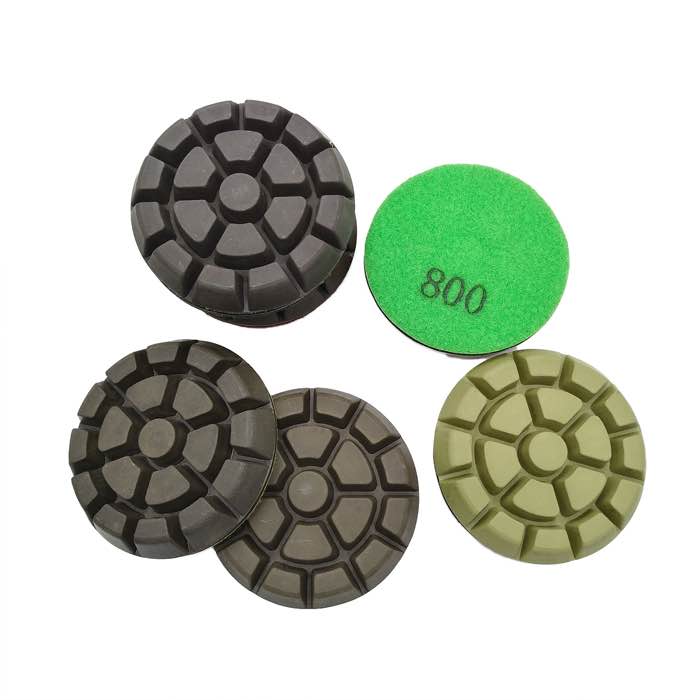
Higher gloss is not automatically more slippery, but a mirror-burnished floor with heavy densifier and no sealer can test lower wet than a satin finish, because the closed surface holds water in a film. A honed or satin polish around 100 to 400 grit. resin polishing pads gives more micro-profile for wet feet and usually scores higher. The practical rule: if the area gets wet or is on a slope, stop the polish at a lower grit and add a slip treatment instead of chasing maximum gloss.
A penetrating sealer that leaves a micro-rough surface helps wet slip resistance without dulling the floor much. Anti-slip additives mixed into the sealer, or a burnishing pad with embedded aggregate, add texture at the finish stage. Etching or light re-grinding with a coarse resin pad. turbo cup wheel creates a slight profile if the floor is too slick. For bathrooms and ramps, combine a lower gloss finish with an anti-slip sealer and verify with a wet test before opening the area.
Never rely on a generic rating; test the finished floor in place, with water, and at the same temperature it will see in use. Walk the floor with wet soles as a quick check, then run a pendulum or DCOF test at the worst spots, such as near doors, drains, and slopes. Keep records of the test results for spec compliance, and re-test after sealing or burnishing, because the last finishing step changes the number.
It can be, especially at high gloss with a smooth sealer. Lower the finish grit, use an anti-slip sealer, and test wet to bring the rating above the safety threshold for the area.
For level indoor floors, a wet DCOF of 0.42 or higher is the common safety target. Ramps and wet areas need higher, around 0.5 or more depending on the local standard.
Choose the finish level and sealer by the room's wet exposure, test the actual floor wet, and add texture or treatment where the rating falls short. Slip resistance on polished concrete is engineered, not accidental, so verify it before the floor opens.
Written and reviewed by JOY TECH - an SGS & BV audited, CE/RoHS certified diamond tools manufacturer founded in 2004, exporting to 50+ countries.
Our factory and quality management system are audited by SGS and Bureau Veritas. Products meet CE/RoHS requirements and every piece is 100% inspected before packing.
Verified Certificates
