Average response time: under 24 hours
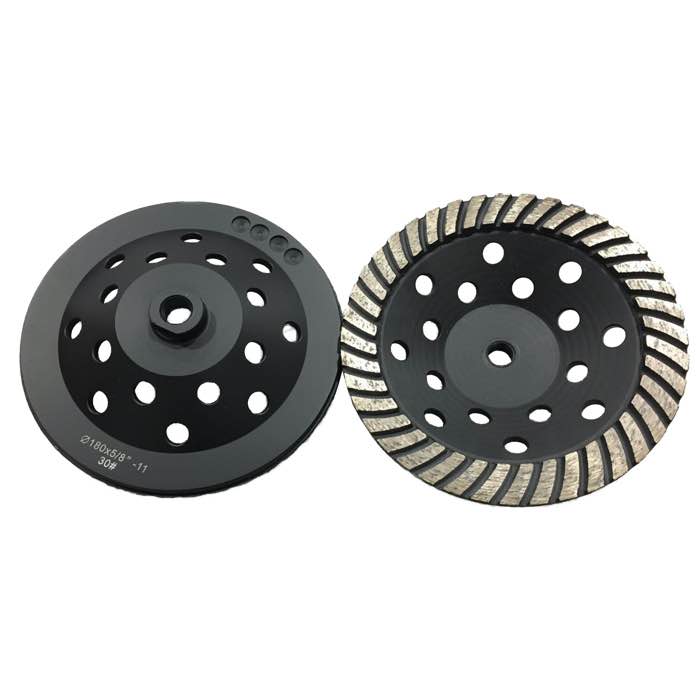
White or hazy residue left by spray-on cure, membrane-forming compounds, construction slurry washes, and formwork release oil will not polish out with a standard 30→1500-grit sequence. You must first remove it mechanically: a 30/40 metal-bond grind with medium-bond segments, followed by a 60/80 pass, and only then move to 150→300. Budget an extra 15–25 m²/hour of production loss and plan densifier application after the 150-grit step, not before. Heavy membrane cure (wax or acrylic) often needs one PCD cup-wheel pass on an angle grinder before the walk-behind touches it.
Three common construction residues show up on new slabs:
Spray a small patch with water. If the residue darkens and stays dark, it is a porous laitance/slurry layer. If it beads and wipes clean, it is a membrane or oil film. Porous residue disappears with a single 30/40 grind. Oily or waxy residue needs PCD or a chemical stripper first — grinding alone smears the oil into the paste.
| Step | Tooling | Production rate | Purpose |
|---|---|---|---|
| 0 (optional) | PCD cup wheel on edge grinder | ~15–20 m²/h | Strip heavy wax/acrylic cure |
| 1 | 30/40 metal bond, medium | ~30–40 m²/h | Open the surface, remove residue |
| 2 | 60/80 metal bond, medium | ~40–50 m²/h | Remove 30-grit scratches |
| 3 | 150 resin or hybrid | ~50–60 m²/h | Mechanical prep before densifier |
| 4 | Densifier | Coverage 4–8 m²/L | Harden exposed paste |
| 5 | 300 → 800 → 1500/3000 resin pads | Standard | Normal polish build |
Use a turbo cup wheel on the edge grinder for stubborn spots — it cuts faster than a flat PCD disc on thin cure residue and leaves a cleaner transition into the walk-behind pass.
Applying densifier before the residue is removed traps the contaminant under the hardener. The result is a floor that looks fine at 400 grit but goes cloudy at 1500 — exactly the "cloudy after densifier" problem that eats warranty calls. Wait until the 150-grit step, sweep, and apply densifier to the clean, opened surface.
A: Mild acid (1:10 muriatic) removes some wax cures, but it also etches the paste unevenly and can trigger efflorescence. Grinding is more predictable on commercial jobs.
A: After the 30/40 pass, wet-mop a test patch. It should dry to a uniform dull gray, no white streaks and no dark oil halos. If halos remain, repeat the PCD or 30/40 pass.
A: Yes — budget an extra $1.50–3.00/m² compared with a clean new slab, and flag it in the quote. Most GC-owned slabs have some residue and the customer expects you to handle it.
A: No. Even a 200-grit honed finish will look blotchy where the cure film survived. Remove it first.
On a 1,000 m² warehouse job where spray cure survived, expect the following added cost compared with a clean slab: 30/40 metal-bond tooling at ~€0.60/m², labor for one extra pass at ~€0.80/m², and wet slurry disposal at ~€0.15/m². Total premium: roughly €1.50–2.50/m². If PCD stripping is needed for a heavy wax membrane, add another €1.00–1.50/m². Flag this on the quote as a contingency line so it does not come out of your margin.
Three conditions make residue removal unprofitable: (1) a floor covered in thick grease or oil that has soaked into 10 mm of paste — grinding will smear it further; (2) a slab with active laitance because it was poured within the last 7 days; (3) acid-etched floors from a failed epoxy job where the paste is already weakened. In each case, recommend a repair or a thin cementitious overlay rather than trying to polish through the damage.
Cure compounds, slurry stains and formwork oil are surface contaminants, not color defects. A clean mechanical sequence — optional PCD strip, 30/40, 60/80, then densifier after 150 grit — restores a uniform finish. Keep a pack of 6-PCD cup wheels and medium-bond trapezoid discs on the truck so a surprise residue layer does not derail a deadline.
Written and reviewed by JOY TECH - an SGS & BV audited, CE/RoHS certified diamond tools manufacturer founded in 2004, exporting to 50+ countries.
Our factory and quality management system are audited by SGS and Bureau Veritas. Products meet CE/RoHS requirements and every piece is 100% inspected before packing.
Verified Certificates
