Average response time: under 24 hours
To grind concrete around drains and utility boxes, protect the fixture with masking tape and a sacrificial cover, then use a handheld angle grinder with a diamond cup wheel to grind a ring around the edge, working outward in overlapping passes. Feather the ground area into the main floor so there is no lip, and keep the disc flat so you do not gouge the concrete beside the fixture. On floor grinders, finish the perimeter zone by hand before or after the main pass, and clean any debris out of the drain before it reaches the box.
Drains, cleanouts and utility boxes sit proud of or flush with the slab, and the concrete around them is always cut, patched or poured separately. That makes the perimeter a mix of joints, high spots and embedded metal that a full-width floor grinder cannot reach safely. Grinding blind around a fixture risks three problems: damaging the fixture, gouging the slab, and leaving a raised ring that traps water or creates a trip edge.
Cover the fixture before grinding. For a floor drain, tape the grate shut and set a sacrificial cover (a piece of plywood or a plastic cap) over it. For a utility box, mask the cover plate and the frame so metal shavings and dust cannot get into the box. Leave the cover in place until all grinding is finished and the area is vacuumed.
Check the frame height. If the box or drain rim stands proud of the slab, plan to grind the concrete down to its level or adjust the fixture later — do not grind the metal frame itself to match the concrete. Grinding metal with a concrete disc damages the segments and leaves a smeared finish.
Use a handheld grinder with a diamond grinding cup wheel. Work from the fixture outward in a spiral or in straight passes that start at the edge and extend about 150-200 mm past the fixture. Keep the cup wheel flat on the floor — tilting it onto its edge cuts a groove beside the fixture. Overlap each pass by half the wheel width so the ring blends into the surrounding concrete.
Move at a steady pace and let the machine weight cut. Where the concrete is patched around the fixture, it is often softer than the main slab, so it removes faster — ease off before you cut a depression. If the frame sits above the concrete, grind right up to the frame and feather the last centimeter by hand with the edge of the wheel.
Stop periodically and check the profile with your finger or a straightedge. The ground zone should transition smoothly to the unground floor with no step. For deep-set boxes, a smaller cup wheel or a triangle pad reaches into the corner better than a large disc.
When using a floor grinder for the main area, grind the fixture perimeters by hand first, then run the floor grinder over the open floor so it overlaps the hand-ground zone and blends the transition. This order avoids leaving a ring of untouched concrete around every box. After the main pass, check each fixture perimeter again and touch up any high spots by hand.
Between passes, vacuum around the fixtures. Grinding dust packs into cracks and will wash into the drain on the first cleaning, potentially blocking it. Use a vacuum with a narrow nozzle to clean the joint where the concrete meets the frame. See concrete grinder dust collection hookups for keeping the whole job dust-free.
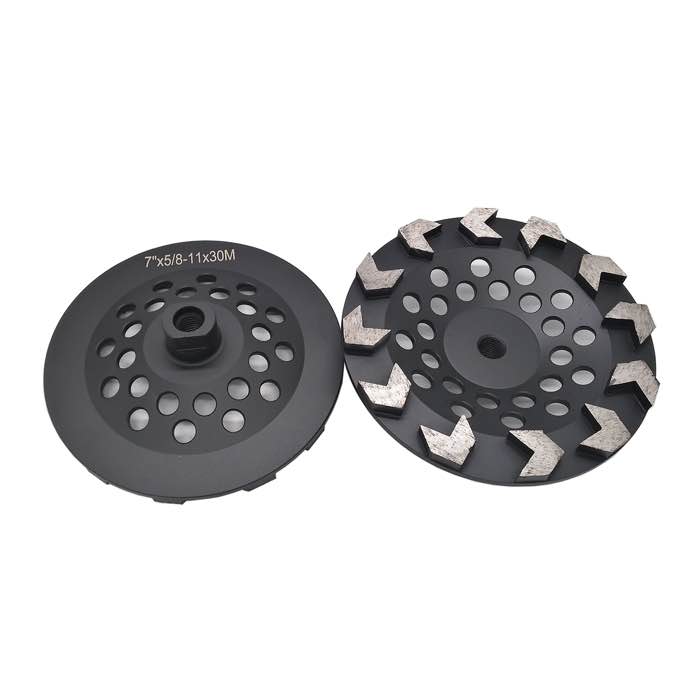
A compact 9-arrow segment cup wheel reaches the tight corners around boxes.
Protect the grate with tape and a cover, then grind outward from the edge with a handheld cup wheel in overlapping passes, feathering into the main floor. Never grind the metal frame itself.
Usually not tight enough. Use a handheld grinder or triangle pad for the perimeter zone, then blend the hand-ground area with the floor grinder passes.
Start with the same coarse grit as the main floor. Because patched concrete around fixtures is often softer, switch to a lighter touch and, if needed, a slightly finer grit to avoid gouging.
Tape the grate shut, cover the fixture, and vacuum around it between passes. Clean the joint after grinding so nothing washes into the pipe later.
Grinding around drains and utility boxes is a hand-tool job done with care: protect the fixture, grind outward with a flat cup wheel in overlapping passes, and feather the edges into the main floor. Do the perimeters before the floor grinder passes so the transitions blend, and keep debris out of the fixtures. The result is a flat, seamless floor around every penetration.
Written and reviewed by JOY TECH - an SGS & BV audited, CE/RoHS certified diamond tools manufacturer founded in 2004, exporting to 50+ countries.
Our factory and quality management system are audited by SGS and Bureau Veritas. Products meet CE/RoHS requirements and every piece is 100% inspected before packing.
Verified Certificates
